WADWAD – Rethinking sediment dynamics at the land-sea interface
The transition zone between land and sea is one of the most dynamic and, at the same time, most sensitive areas of our coasts. Sediment movements, currents and human interventions play a decisive role in determining the stability of the Wadden Sea, one of Europe’s most valuable ecosystems, which is increasingly threatened by rising sea levels, climate change and human interventions.
The aim of the WADWAD project is to develop, at a trilateral level (the Netherlands, Germany, Denmark), an innovative, climate-resilient and ecosystem-based action plan for the Wadden Sea to protect the land-sea transition zones. This action plan aims to develop local solutions to the future challenges facing the Wadden Sea, drawing on knowledge from various disciplines, the expertise of decision-makers from politics, administration and management, and the views of residents along the North Sea coast. The focus here is on generating knowledge about the impacts of sediment dynamics, climate change and ecosystem loss.
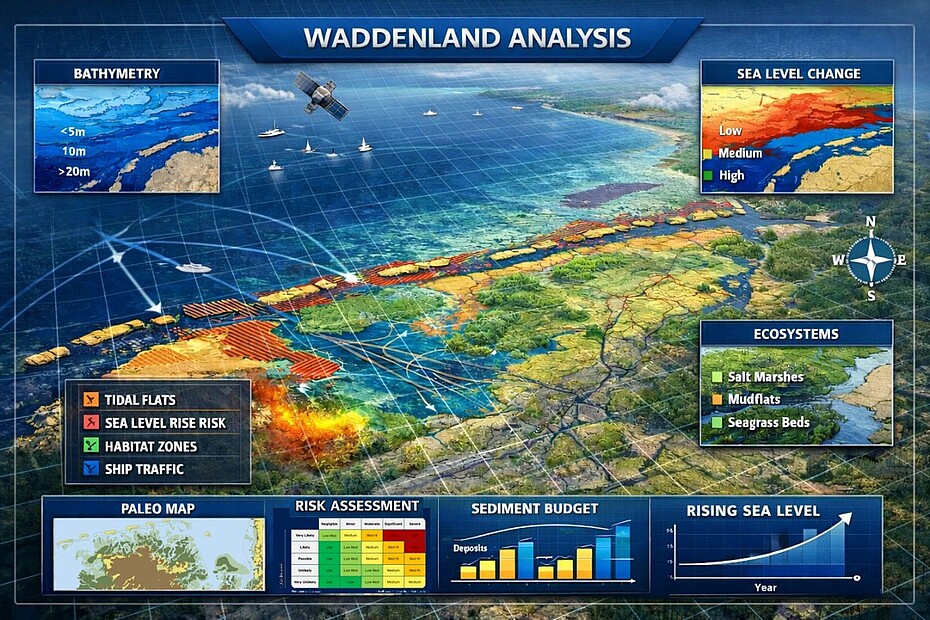
A key work package of WADWAD is based at the NIhK and is dedicated to the development of GIS-based applications for the analysis and visualisation of risk and potential areas. Based on geoscientific, historical and palaeoecological data, multifactorial maps – known as ‘heatmaps’ – are being produced to identify both particularly vulnerable areas and promising sites for pilot projects. The focus here is on the sedimentary subsoil as a key component of coastal dynamics.
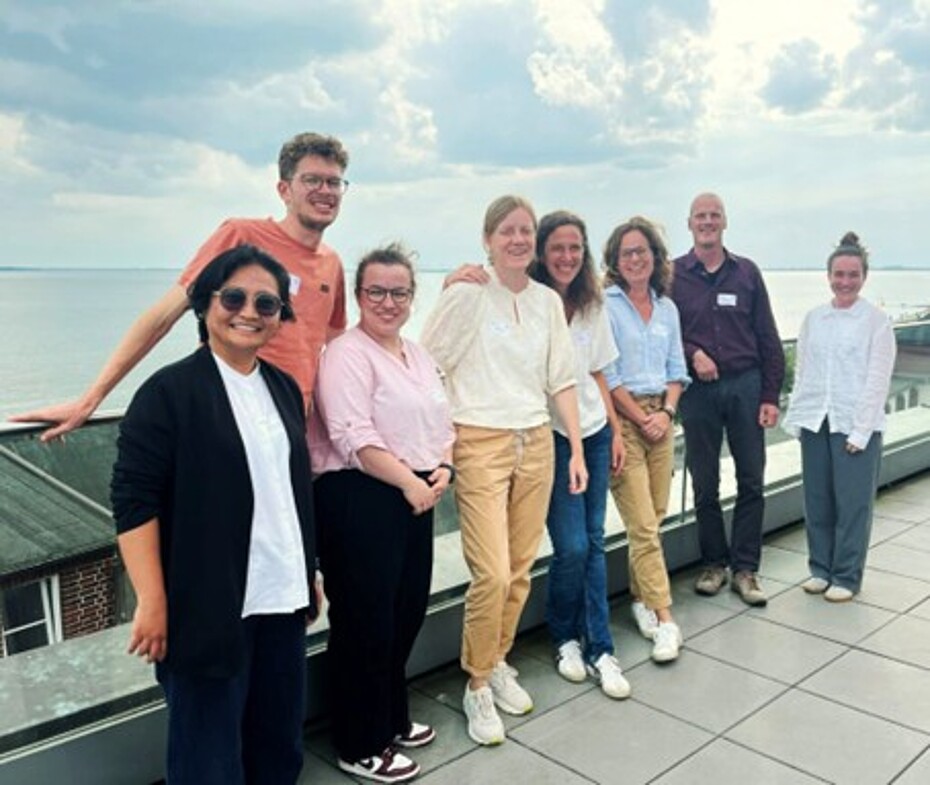
The work package is led by Dr Martina Karle and Dr Friederike Bungenstock. Minne Oostra works on the project as a research assistant.
WADWAD is a four-year collaborative project, planned for the period 2025 to 2028, between the universities of Oldenburg, Groningen, Utrecht and Copenhagen and the institutes Deltares, Senckenberg am Meer and NIhK. The project is funded by the Federal Ministry for Research, Technology and Space (BMFTR), the Federal Ministry for the Environment, Nature Conservation, Nuclear Safety and Consumer Protection (BMUV) and the Netherlands Organisation for Scientific Research (NWO) as part of the programme ‘Understanding complex pressures on the Wadden Sea and options for action’ (https://www.nwo.nl/en/news/five-applications-awarded-for-research-about-the-wadden-sea). The project is managed by Projektträger Jülich (PtJ) and the NWO on behalf of the participating ministries (https://geschichten.ptj.de/internationale-wattenmeerforschung#353426199). This research programme focuses on the complex pressures and cumulative impacts on the ecosystem, the options for action, and the consequences for the lives of people in the coastal region. A total of six projects are being funded:
WADWAD – Action plan for ecosystem-based land-sea transition zones (https://wadwad.uol.de/project/)
PaRCA – Approaches to implementing climate adaptation in the Wadden Sea (https://www.parca-waddensea.net/).
SedWay – Safeguarding natural sedimentation processes in the Wadden Sea for biodiversity and people (https://uol.de/ecoeco/forschung/sedway).
TRICMA² – The triple crisis meets trilateral cooperation: the impacts of biodiversity loss, climate change and environmental pollution on salt marshes and pathways to their sustainable management (https://www.biologie.uni-hamburg.de/forschung/angewandte-pflanzenoekologie/drittmittelprojekte/tricma2.html).
SALTGARDEN – Sustainable adaptive landscapes through transdisciplinary gardening to promote the resilience and dynamism of our ecological natural heritage (https://www.lufi.uni-hannover.de/forschung/forschungsprojekte/forschungsprojekte-detailansicht/projects/saltgarden-nachhaltige-adaptive-landschaften-zur-foerderung-der-widerstandsfaehigkeit-und-dynamik-des-naturerbes-wattenmeer).
WADcouple – Synthesis and Transfer Initiative of the trilateral Wadden Sea Research Programme (https://wadcouple.uol.de/).