
Research Group FOR 5837 | TORF – Times of Rise and Failure – Integrative Research on the development of the cultural landscape in the North Frisian Wadden Sea region over the last two millennia
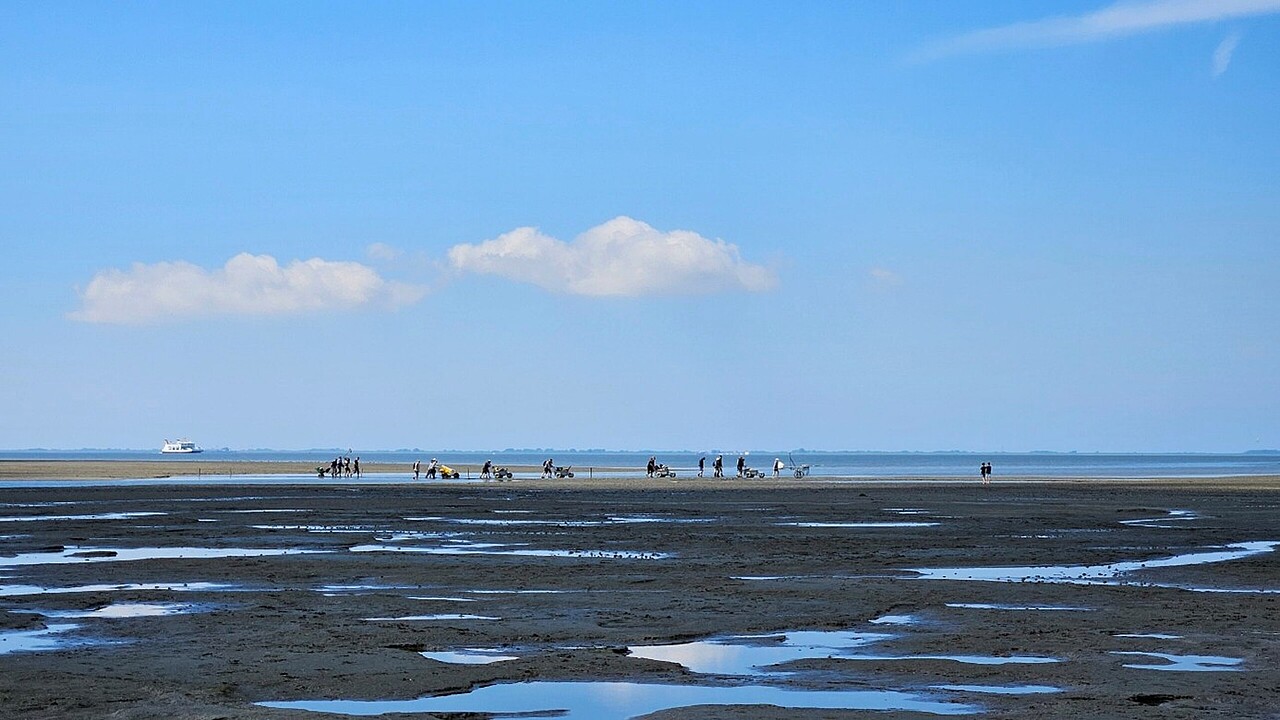
The Research group aims to perform systematic and multidisciplinary investigations and spatio-temporal reconstructions of the medieval coastal landscape of North Frisia (Schleswig-Holstein, Germany), which was drowned during a severe storm surge in 1362 AD. Numerous remains of the once cultivated land are still hidden beneath the tidal flats, wich form part of the UNESCO World Heritage Site ‘Wadden Sea’. As large areas of the submerged medieval landscape now lie withing the Wadden Sea, their preserved traces and settlement remains provide a time capsule of the medieval cultural landscape. As part of the cultural heritage, these widely preserved structures are of great value reconstructing the landscape history of North Frisia and the wider Wadden Sea region.
The main aims of the research group are
- Capturing, reconstructing and investigating the various human-environment interactions
- Understanding the successes and failures of human efforts to secure resources, expand settlements and combat land loss caused by extreme events
- Achieving a better understanding of the region’s cultural heritage and raising public awareness for natural hazards in coastal areas.
The group comprises seven sup-projects (SPs) plus coordination. Researchers from archaeology (SP1), geophysics (SP2), physical geography (SP3), geology (SP4), history (SP5), microbiology (SP6) and computer science (SP7) are working together in an interdisciplinary team. The institutions involved are the Institute of Geography at the University of Mainz, the Leibniz-Centre for Archaeology (LEIZA) with locations in Mainz and Schleswig, the Schleswig-Holstein State Office for Archaeology (ALSH), the Historical Seminar, the Institute of Clinical Molecular Biology, the Institute of Geosciences and the Institute of Pre- and Protohistoric Archaeology at Kiel University, the NIhK and other cooperation partners.
The research group builds on the intensive research conducted in the North Frisian Wadden Sea over the past ten years. Among others, this work led to the discovery of a large church – probably associated with the medieval trading centre of Rungholt – about 7 km off the coast of the Nordstrand peninsula.
With SP4the geological work is based at the NIhK. Local and regional relative sea-level (RSL) changes will be reconstructed, with focus on medieval times. These RSL reconstructions will help to better understand the relationship between human settlement and human impact on the coastal environment. This will be achieved by developing microfauna-based transfer functions for RSL change, which will be applied to Holocene sediment archives. Dr Juliane Scheder was appointed to the project, having developed expertise in this field through previous NIhK projects. The sup-project is led by Dr Friederike Bungenstock.
The research group FOR 5837 |TORF - Times of Rise and Failure, funded by the German Research Foundation (Deutsche Forschungsgemeinschaft, DFG) started in April 2026.