
The NIhK takes part in Wilhelmshaven’s ‘Long Night of Science’
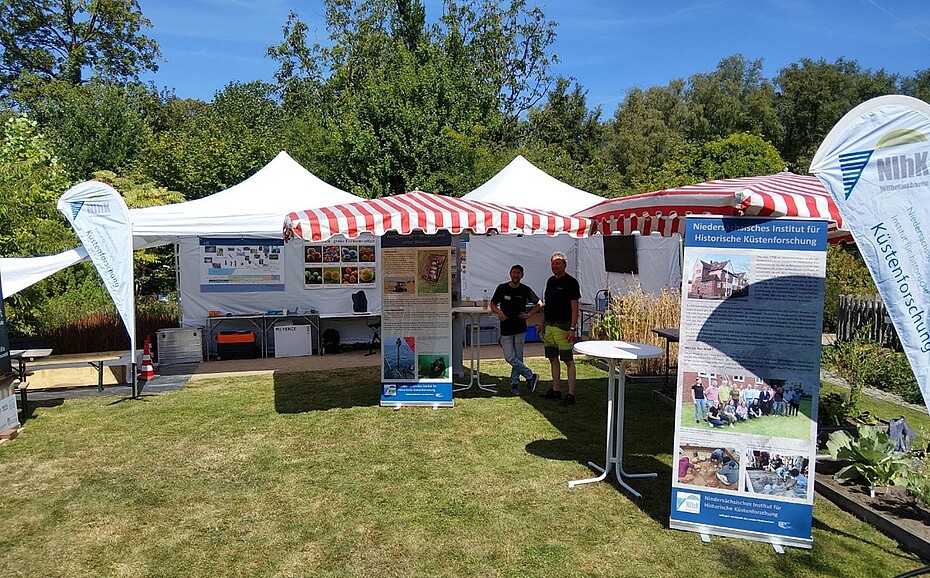
Following a one-year hiatus, the Long Night of Science, organised by the North-West German University Association, took place once again on 14 August. This year’s venue was once again the Wilhelmshaven Botanical Garden on Neuengrodener Weg. The NIhK took this opportunity to provide visitors with detailed information about its research and to give them an insight into the methods used at the institute. Visitors listened with great interest as the archaeobotany team explained how fossilised pollen grains can be used to reconstruct vegetation changes in the coastal region over the last 15,000 years since the last Ice Age. The drill cores presented by the NIhK also attracted a great deal of attention; these were opened, documented and sampled by the geologists on site so that visitors could learn about recent geological history and sedimentation dynamics along the coast Visitors were invited to touch the different sediments themselves and feel the differences in the composition of the layers. This was complemented by a simulation of the ebb and flow of the tide using a small terrain model featuring tidal flats and tidal channels. The significance of this geological research for coastal protection was also explained in a talk on stage. Naturally, information was also provided on how archaeological excavations are carried out, what artefacts can be unearthed in the north-western German coastal region, and what insights they provide into life in the past. The significance of graves in this context was explained in a further talk on stage. Once again this year, a small excavation site proved to be a particular attraction, where a team of children uncovered a human skeleton – the fact that it was made of plastic made no difference whatsoever to the young researchers.