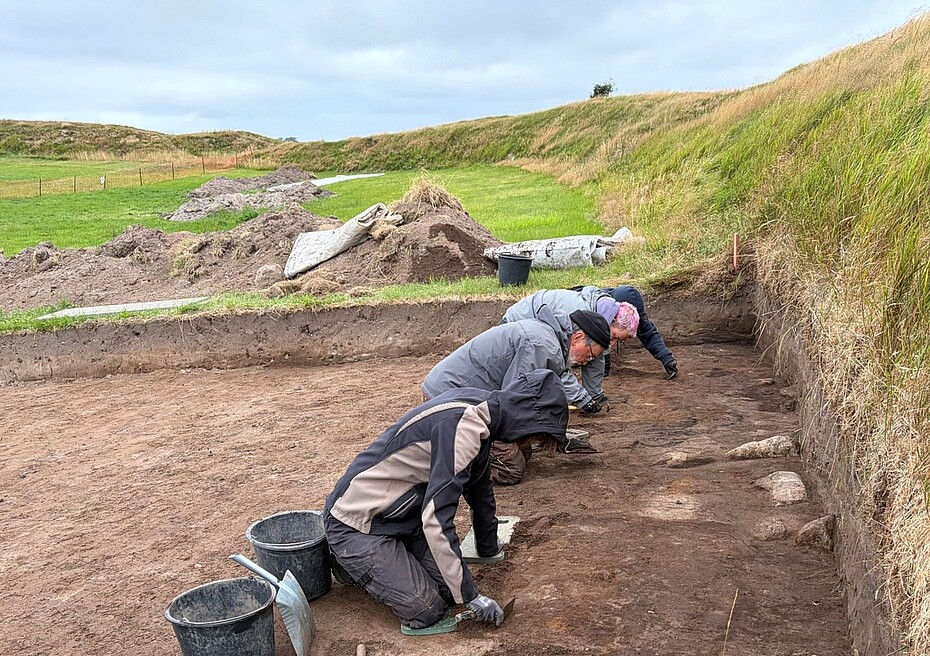
News from the excavations in the Borgsumburg on Föhr
This summer, excavations at the early medieval ring fort near Borgsum will resume once again. The very well-preserved 10th-century AD fortification contains settlement layers approximately four meters thick. Due to the high soil moisture, all organic remains have been exceptionally well preserved, so that the layers of finds include not only loom weights, spindle whorls and animal bones, but even textile fragments, feathers, and eggshells. These provide valuable information about diet and craftsmanship within the fort. Furthermore, the minimally invasive excavation trenches revealed three sod-walled houses, a cistern, and several hearth sites. The new findings help to better interpret the geophysical measurement results and answer questions about the stronghold’s age and function. This applies in particular to the most recent phase, which dates to around 980—the time of the Danish King Harald “Blue Tooth” Gormsson. The Borgsum Castle thus aligns chronologically and structurally with the Danish Trelleborgen, which were designated as a World Heritage Site some years ago.