What historical potsherds tell us about the Frisian castle-site of Tengshausen/ Wangerland
As part of the project ‘Manifestation of Power – Castle Construction as an Indicator of Social Transformation Processes in the Lower Saxony Coastal Region’, castles on the East Frisian Peninsula were examined. The research revealed that the former chieftain’s castle at Tengshausen in Wangerland is one of the few undisturbed fortifications of this kind.
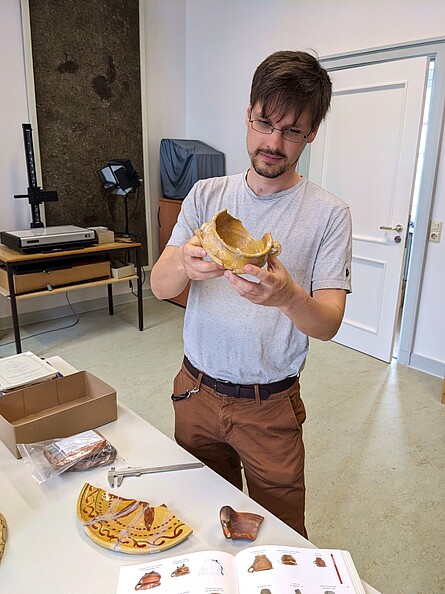
Funded by the German Research Foundation (DFG) these investigations were carried out together with the Internationalen Jugendgemeinschaftsdienste (ijgd) and students from the universities of Tübingen and Heidelberg. The archaeological excavation yielded numerous finds made of ceramic, glass, and metal. As part of the ongoing analysis, the approximately 660 ceramic sherds are being examined in detail to determine their age, function and place of manufacture. They consist primarily of fragments of drinking, cooking, and serving vessels.
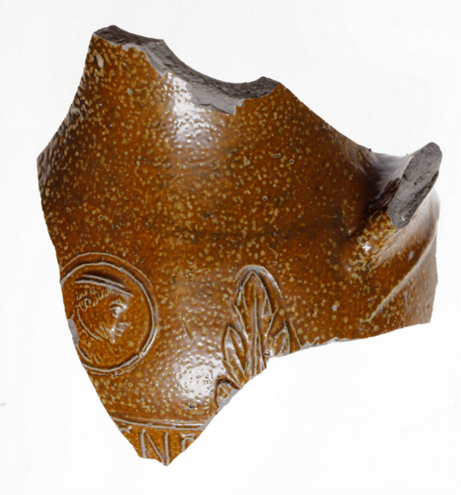
However, few of the found vessels were produced in the Frisian coastal region; most of the objects were imported from the Rhineland or the Netherlands. Among the most striking pieces is a shard of a jug produced in a pottery workshop in Cologne or Frechen. The stoneware vessel is decorated with an inscription that is no longer legible, acanthus leaves, and round appliqués depicting a man. This figure is dressed in clothing typical of Renaissance fashion. The shard can therefore be dated to the mid-16th century.
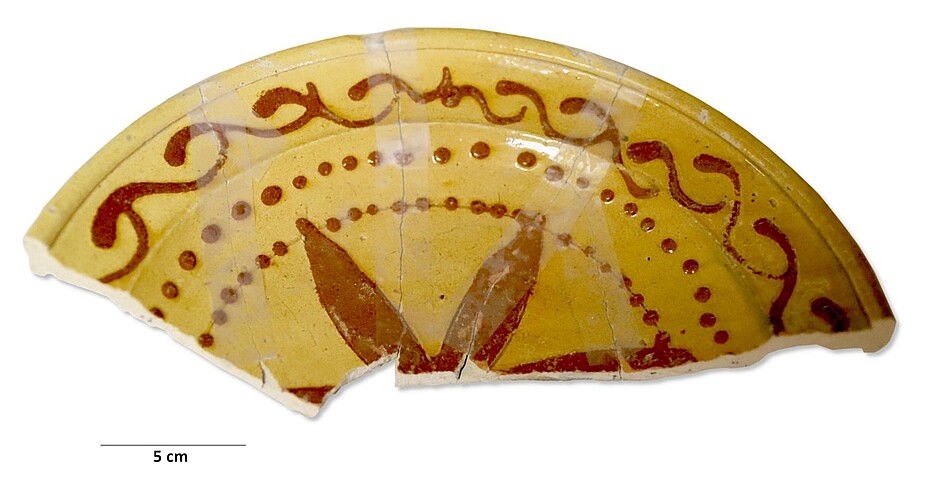
Numerous plate fragments were painted with geometric and floral patterns. The lines of these decorations were created using clay slip applied with a slip trailer (a so-called „Malhorn“).