Heligoland flint collection handed over to the NIhK
For decades, Jaap Beuker, the former chief curator of the Drentsmuseum in Assen, the Netherlands, has been conducting research into Heligoland flint. His work focuses not only on the well-known red flint, but also on yellow flint, so-called ‘bone flint’ and, above all, Heligoland slab flint.
The latter, in particular, appears to have been used on the mainland much more frequently than was expected just a few years ago. These finds illustrate particularly well how, as far back as the Stone and Bronze Ages, people transported goods across the North Sea from Heligoland to the mainland. A book on this very subject has just been published by Jaap Beuker in collaboration with colleagues from Denmark, Schleswig-Holstein and Wilhelmshaven.
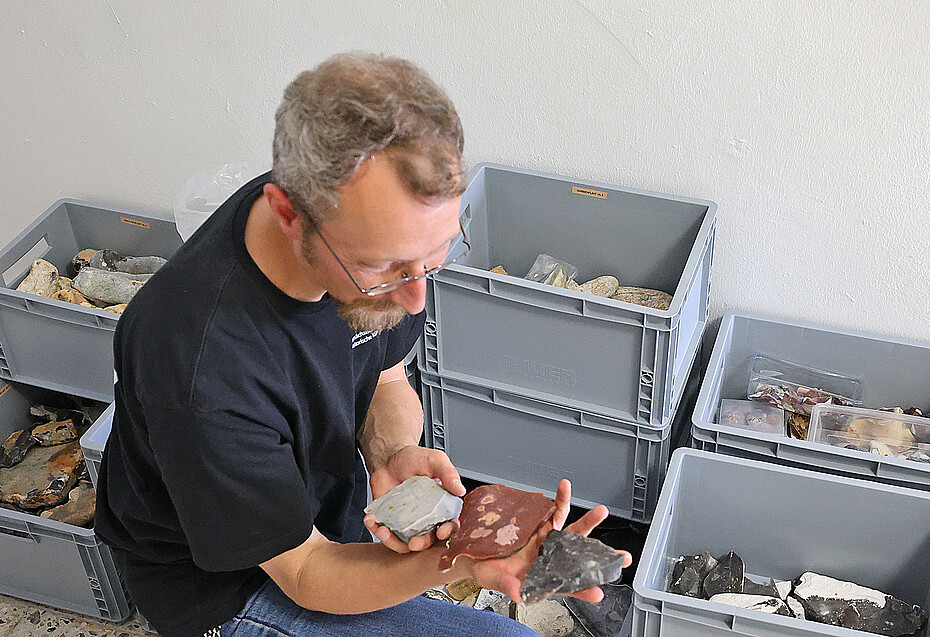
In order to be able to identify the slab flint with certainty, Jaap spent a long time collecting flint from various natural deposits in Scandinavia, mainland Germany, Belgium, France, the Netherlands and, of course, Heligoland, thereby building up a large reference collection.
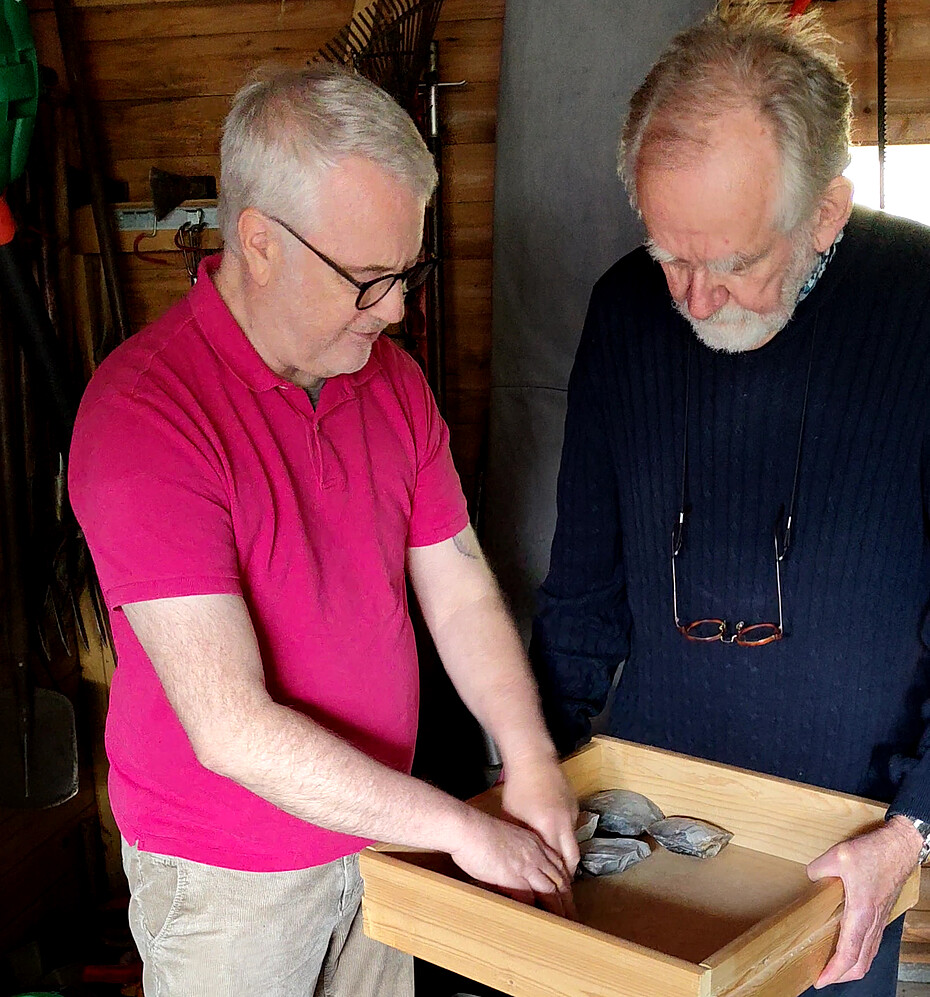
He has now donated this life’s work to the NIhK, entrusting it to the care of Martin Segschneider and Moritz Mennenga. Here, the stones are not only archived, but also made available for the day-to-day work of colleagues at the institute, as well as for all other researchers.
This unique collection of comparative artefacts serves as a basis for reconstructing the trade and exchange links that existed in the North Sea region as far back as 5,000 years ago.