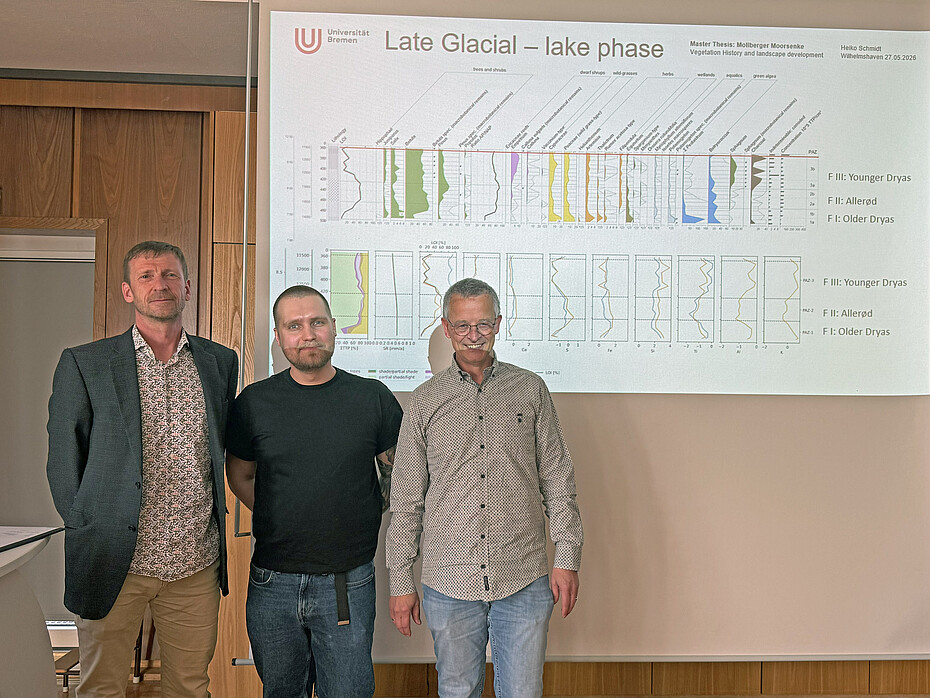
Master’s Thesis on the Environmental History of the Mollberg bog defended at the NIhK
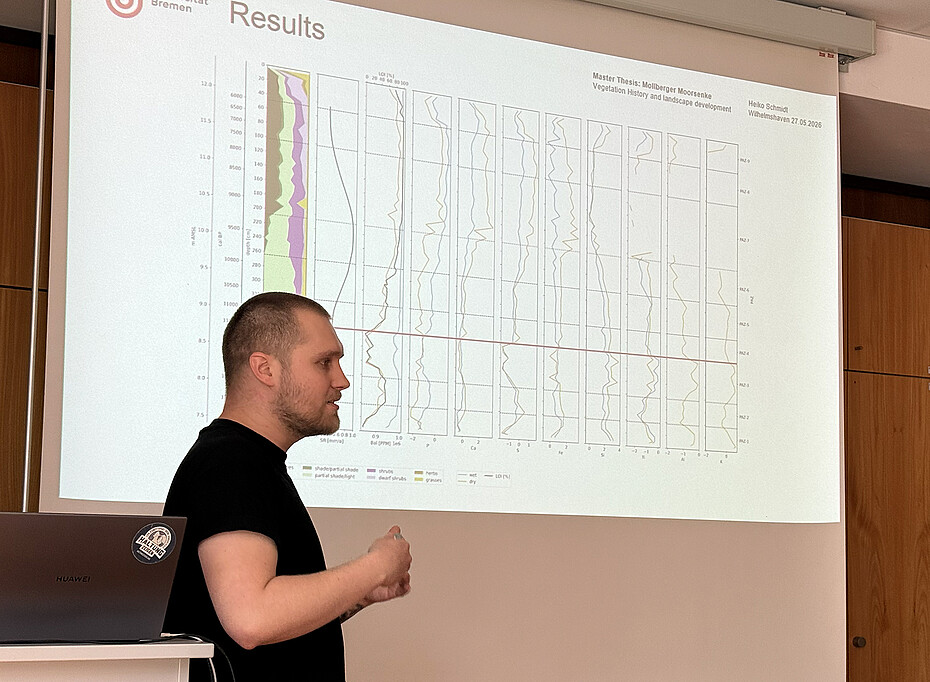
Although the NIhK is a non-university research institution, it regularly hosts BA and MA candidates. Students from a wide range of universities—both national and international—conduct research at the NIhK on various topics related to historical coastal research. In doing so, they utilize the institute's existing infrastructure and the team's expertise, thereby contributing to scientific progress in the study of the landscape and settlement history of the North German coastal regions.
Most recently, Heiko Schmidt defended his master’s thesis—submitted to the University of Bremen as part of the "Physical Geography: Environmental History" program—before an audience in the NIhK’s lecture hall.
This research-oriented master’s program (M.Sc.) combines approaches from the natural sciences and the humanities to reconstruct climate and environmental changes. It is jointly supported by the Institute of Geography and the Center for Marine Environmental Sciences (MARUM) at the University of Bremen, as well as the NIhK.
For his master's thesis, Heiko Schmidt conducted vegetation-history analyses on core samples from the Mollberg bog depression (approx. 5 m deep) in the Ammerland district. The topic was suggested by colleagues in Wilhelmshaven, and both the laboratory analysis and academic supervision took place at the NIhK.
As part of his examination, Heiko Schmidt presented his key findings in a short talk, demonstrating that deposits preserved within the Mollberg bog depression allow for a reconstruction of regional environmental development since the end of the last Ice Age. The shape and relief of the depression suggest it was formed by the growth of a pingo during a cold period. Pingos form when groundwater freezes into ice lenses under permafrost conditions (permanently frozen ground); these lenses can heave the overlying soil by tens of meters. When permafrost conditions ended with the Ice Age, the ice lens melted and the system collapsed, leaving behind a small lake just under 200 meters in diameter. Over the following millennia, the lake filled in with sediment and evolved into a kettle bog.
His supervisors, Prof. Dr. Felix Bittmann and Dr. Steffen Wolters, as well as numerous NIhK colleagues and several external scientists attended the public exam. Following the presentation, the candidate answered in-depth questions regarding his methodology and results to the great satisfaction of his examiners. The master's examination was a success, allowing guests and NIhK staff to congratulate Heiko Schmidt on the excellent completion of his studies.