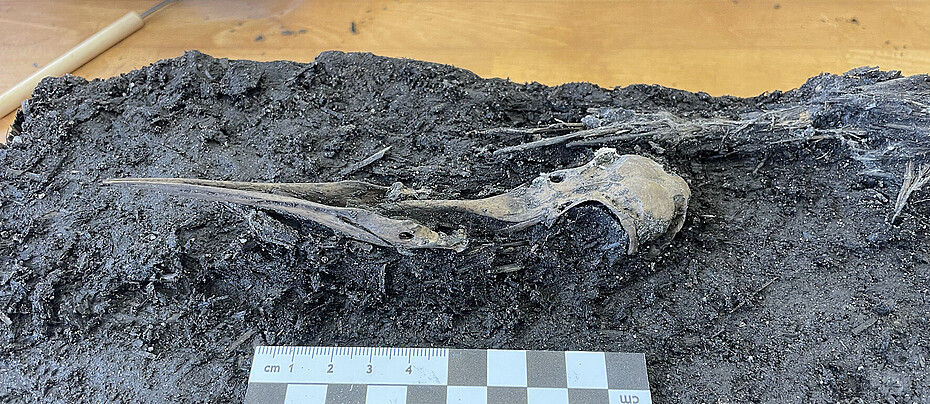
Preserved in sediment: block recovery of guillemot skeleton remains in Borgsumburg
Guillemots are rock-breeding seabirds that occur, e.g., on Heligoland, but not along the Wadden Sea coast. During excavations at the early medieval Borgsumburg on the North Frisian island of Föhr, several bones of guillemot skeletons were discovered at a depth of about 2 metres. Due to their good state of preservation, with some of the plumage still present, they were recovered in three blocks. These extraordinary finds are being processed in collaboration with Natascha Alexandra Kipke, MA (LEIZA) and Prof. Ben Krause-Kyora (University of Kiel).
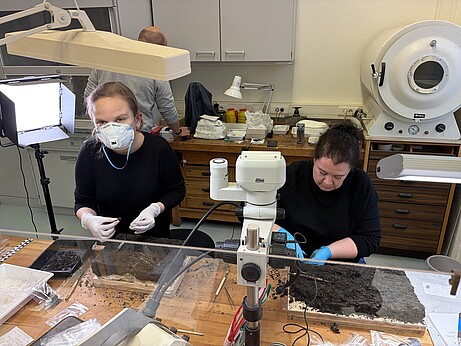
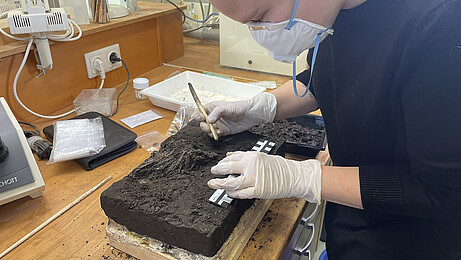
The blocks containing the guillemot remains, which were frozen after recovery and have now been thawed, have been carefully removed layer by layer by the Borgsumburg project team (Dr Martin Segschneider, Dr Kirsten Hüser and Pière Leon Frederiks MSc) and Natascha Kipke in the NIhK restoration workshop. In addition to the bones and feathers of the birds, other finds such as mussel shells, pieces of wood and animal hair were discovered in the blocks of earth. For genetic testing, DNA samples were taken from the surrounding soil and from the guillemot feathers during the preparation process.